
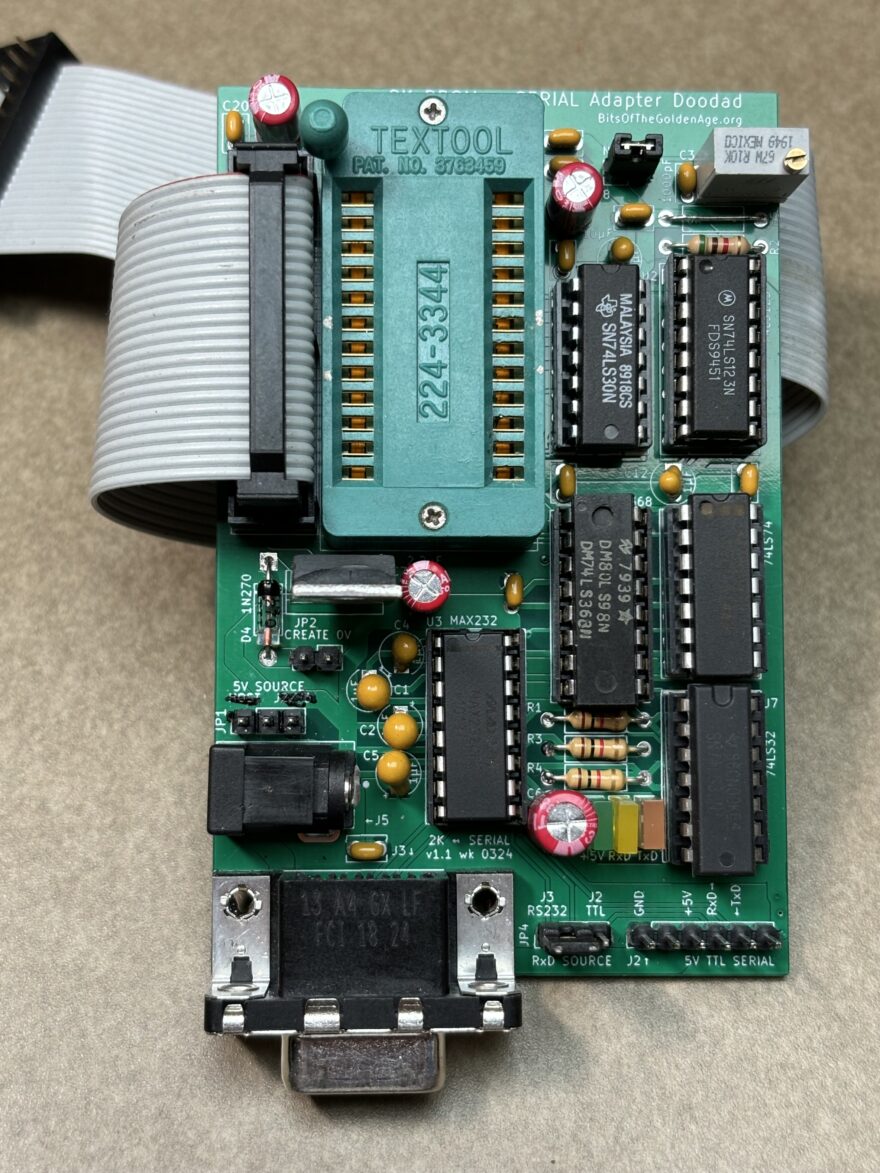
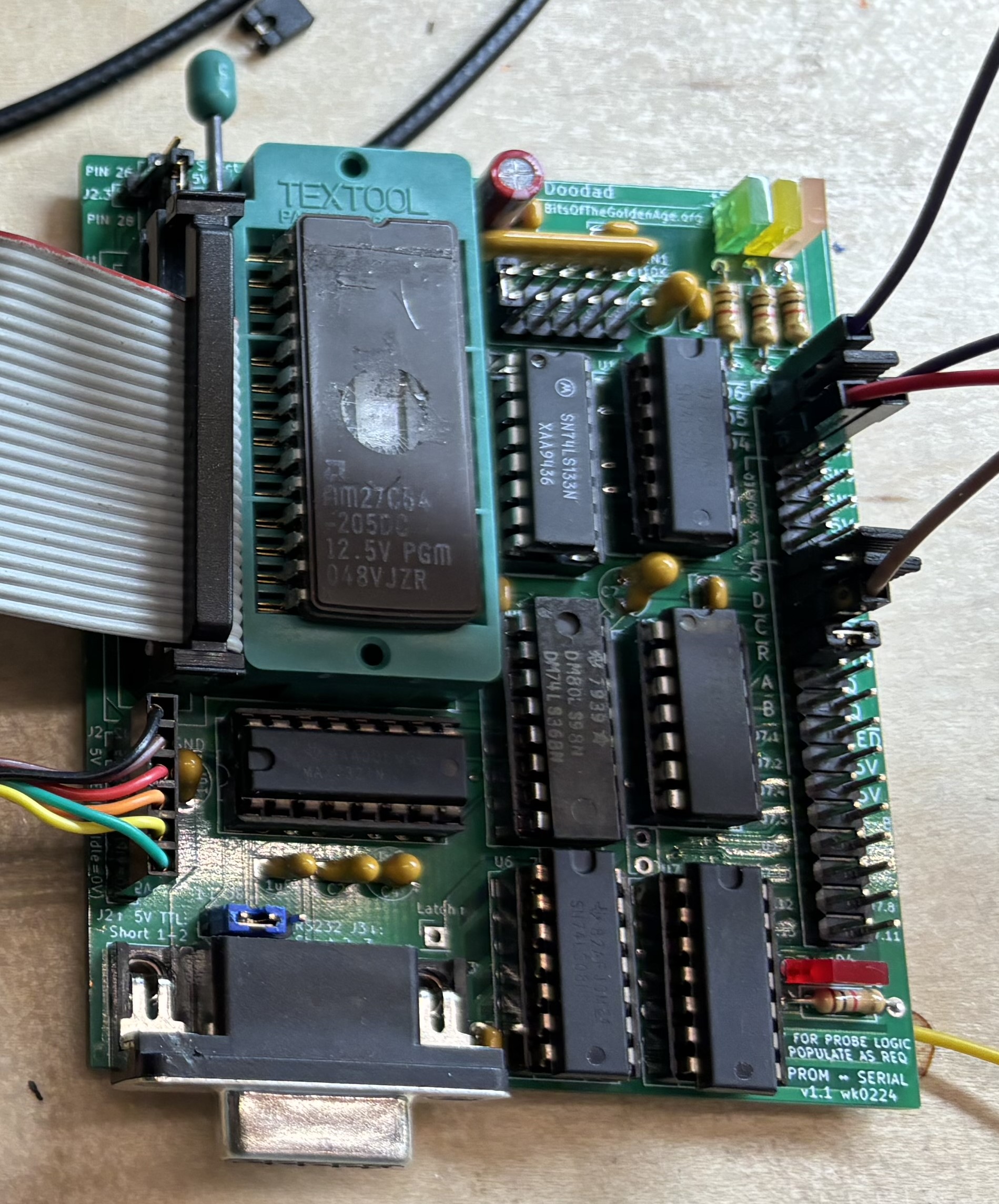
I tend to work on a lot of CPU hardware that has no documentation, sometimes components are missing, or the board is just too broken to show any significant signs of life. Frequently the board has RAM and a bit banged serial port or UART, but I have no idea of any jumper settings, memory mapping, or port configurations. Nonetheless, my first order of business is always to establish communication with test programs that I have written to explore and test the hardware because as soon as possible I want to use software running ON the board to control signals, rather than relying on signal injection and tracing with logic analyzers and oscilloscopes.
That is the whole purpose of the PROM to Serial Port Adapter Doodad. As soon as a board is to the point where it can fetch an instruction from its ROM, I can begin writing test programs to run on the board and communicate with those programs using a serial port and terminal.
One of these Doodad dongles are plugged into the first instruction fetch ROM socket and my test programs are loaded into an EPROM that is now on the Doodad’s ZIF socket. The Doodad creates a bidirectional, bit banged serial port for the test programs to communicate with a terminal. Coupled with RAM-Less test software, this allows the test software to then determine the appropriate bit delay value for the target baud rate and establish two way communication between the terminal and test software. Once communication is established, the battle has been won and the rest is just filling in details.
Since the 1702 EPROM has significantly different operation requirements (e.g. floating ground), there is a board just for 1702(A)s and then another board for 2708 EPROMs and larger.